01
Three departments, three revenue figures
Finance counts differently from sales, and the shop reports a third number. The meeting opens with an argument about which figure is right instead of with the decision.
Hellsicht brings the information out of your IT systems together on Microsoft Fabric, into one data foundation every department refers to. Our connectors reach any ERP, online store or CRM. Built by people who know Dynamics 365 from the inside.
Four situations from almost every first conversation, one answer, and what you get out of it. No jargon.
Architecture, ingestion, method: the platform as a software project, with versions, pipelines and permissions.
Departments
The companies we talk to rarely have too little data. What they have is an access problem: the numbers sit in the ERP, the shop, the CRM and a handful of spreadsheets, and by the time anyone can stand behind an answer, the week is gone. That is why Microsoft Fabric is on the table at all.
Four situations we meet in almost every first conversation
Finance counts differently from sales, and the shop reports a third number. The meeting opens with an argument about which figure is right instead of with the decision.
Between the transaction and the report sits an overnight export. Anyone who needs to act today messages a colleague on Teams and has them look it up in the system.
One more analysis means a ticket, a prioritisation and a queue. In the meantime the department rebuilds it by hand in Excel — hours that are missing from the work they were hired to do. And questions that take two weeks to answer eventually stop being asked.
One colleague knows the file, the formulas and the exceptions in it. When they are away, the report waits. When they leave, the knowledge goes with them.
Microsoft Fabric is not another tool alongside the ones you have; it is the common ground underneath them. Your systems are connected once, and after that the data sits in one place. Ingestion, preparation, analysis and monitoring all work on that same set instead of each keeping a copy of it.
What that means for you
A figure every department can point to — even when three systems feed it.
Reports that follow the business rather than last night's export.
Fabric runs inside the Microsoft environment you already have: sign-in and permissions through Entra ID, one capacity instead of four separate products.
What Fabric does not fix: data nobody owns, and metrics nobody has agreed on. We work through both with you in the workshop, before the first pipeline runs.
You decide how much you take on and where we step in: a turnkey data platform or a single data model built to order, an existing landscape migrated or a new one started on a clean sheet.
Wherever you are starting from
Grown over years
Export jobs, SQL databases that grew one column at a time, a warehouse nobody wants to touch. We keep the logic that has earned its place and leave the ballast behind. Your reports keep running — underneath, Fabric does the work.
A clean sheet
You start with nothing to carry over, and your sources land straight in OneLake. From the very first table, one harmonised foundation for reports, real-time analytics and exports — one that keeps growing with the business.
The steps to a complete data platform
We set up your Fabric environment and connect Dynamics 365 F&O, or whichever systems you run: scheduled, monitored, repeatable. No hand-carried transfers, no fixes you did not see coming.
Raw tables become clean, documented models for finance, procurement and production — built so the next project reuses them instead of reinventing them.
Reports in Power BI your teams can take further themselves. Or a clean export into whatever downstream systems consume your data. You decide where the numbers land.
After go-live we watch the pipelines, the capacity and the cost, so we catch a failure before it reaches anyone's report. And when new sources or new figures come along, the platform grows with them.
ERP experience
The quality of a data platform is not only a technical question. Because we understand the systems underneath, we know which information matters and which can be left out. So your decisions always rest on the right data.
Not a wall of logos, but projects we can talk through in detail. Ask us about the parts that got difficult.
The starting point: moving to D365 F&O took the existing CSV-based reports with it, and all of them needed replacing.
What we built: Fabric Link brought the D365 F&O data in as fast as the database copies of the legacy systems or the online store did. That let us replace the existing reports at short notice — and build new analyses on Power BI on top of them.
Since we moved to Fabric Link our reporting feels like a different thing: instead of waiting on a daily CSV export, we reach our data in real time.
Outcome
A conversation, not a presentation: you describe your systems, we tell you what Fabric can do there and what it cannot.
We connect your data sources through modern pipelines and dataflows and harmonise them into a single source of truth. The result: real-time analysis, reports and exports worth acting on — decisions resting on a data foundation you can trust. And we build all of it with modern methods: with Git, deployment pipelines and permissions down to row level.
The platform
We build your data platform the way software is built: with versioned changes, development pipelines and dedicated permissions. That is what keeps changes and extensions possible long after go-live.
We are convinced that a shared understanding early on heads off a great many problems later. Workshops are how we make sure it is there.
Every change is versioned in the Git repository, then built and carefully reviewed in a dedicated development workspace.
Your key users check that it holds up for the business and works in their daily routine. All of it isolated from live operations.
Authorised users get access to the new features in the production workspace. With granular permissions right down to row level.
Request your personal access to our Fabric demo environment on the Contoso dataset from Dynamics 365 F&O. Explore the platform at your own pace.
Our team is compact, so from first contact to handover you talk to the people who also build your platform. And they sit in Gießen, not in another time zone.
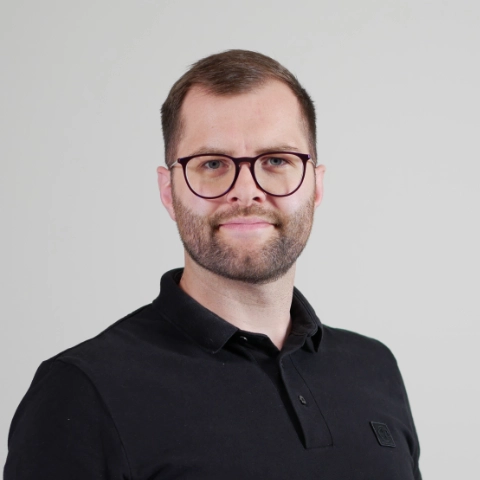
Data Solution Architect & CEO
Ralf has come at Dynamics from every side: he started out at an implementation partner, deepened it in-house at two end customers, and then spent four years freelancing. That route has put him in front of a wide range of business processes, data structures and interface builds.
It was his last project as a Dynamics freelancer that surfaced the need for Fabric — and that project ended with Fabric successfully implemented.
A consistent, fast data landscape only gets built on a real understanding of the data underneath it.
Consultant Data & Analytics
Björn comes from the day-to-day of ERP with Microsoft Dynamics: first on the technical side, running test automation and data migrations through a Dynamics AX 2012 implementation, then at a second company improving a live Dynamics AX 2012 as an IT consultant for SCM and EDI.
Because he knows how a value chain is modelled inside an ERP, he can lay the same chain out just as legibly in Fabric. Talking things through properly with our clients' key users matters to him above all.
Most data problems are process problems that nobody has written down yet.
Our office sits in the Technology and Innovation Centre in Gießen, among start-ups, research and mid-sized industry. We are rooted in Hesse and intend to stay: the people you work with are within reach, not a time zone away.
Whether you are still weighing up what Fabric covers and what it costs, or you already have firm requirements for your new data platform: you get a clear, honest read on what Fabric can do for you, and a plan that takes you there quickly.
Choose your next step with us
You describe your systems and your question. We tell you what Fabric can do for you and what it cannot. We are open about the likely costs too.
We give you personal access to our Fabric demo environment. You get to look around yourself, at your own pace.